


2026 Iowa Home Siding & Window Replacement Guide

What if the biggest threat to your home's value isn't the Iowa snow, but the moisture silently trapped behind your aging siding? It's a common fear for Des Moines homeowners who know our climate doesn't play fair. Deciding on a home siding and window replacement project is a major investment, and it's natural to feel overwhelmed by material choices or the logistics of coordinating different crews. You want an exterior that stands up to humid July afternoons and sub-zero January nights without the constant worry of hidden rot or rising utility bills.
We understand that a renovation of this scale feels like a lot to manage. That's why we've built this 2026 guide to help you take control of your home's transformation. You'll learn how to plan a cohesive project that treats your home as a single, protected system rather than a collection of separate parts. We'll walk through the latest energy-efficient materials, explain the updated 2024 International Residential Code requirements, and show you exactly how a unified design-build approach can turn a complex renovation into a smooth, rewarding experience.
Table of Contents
Assessing Your Home: When to Replace Siding and Windows Together
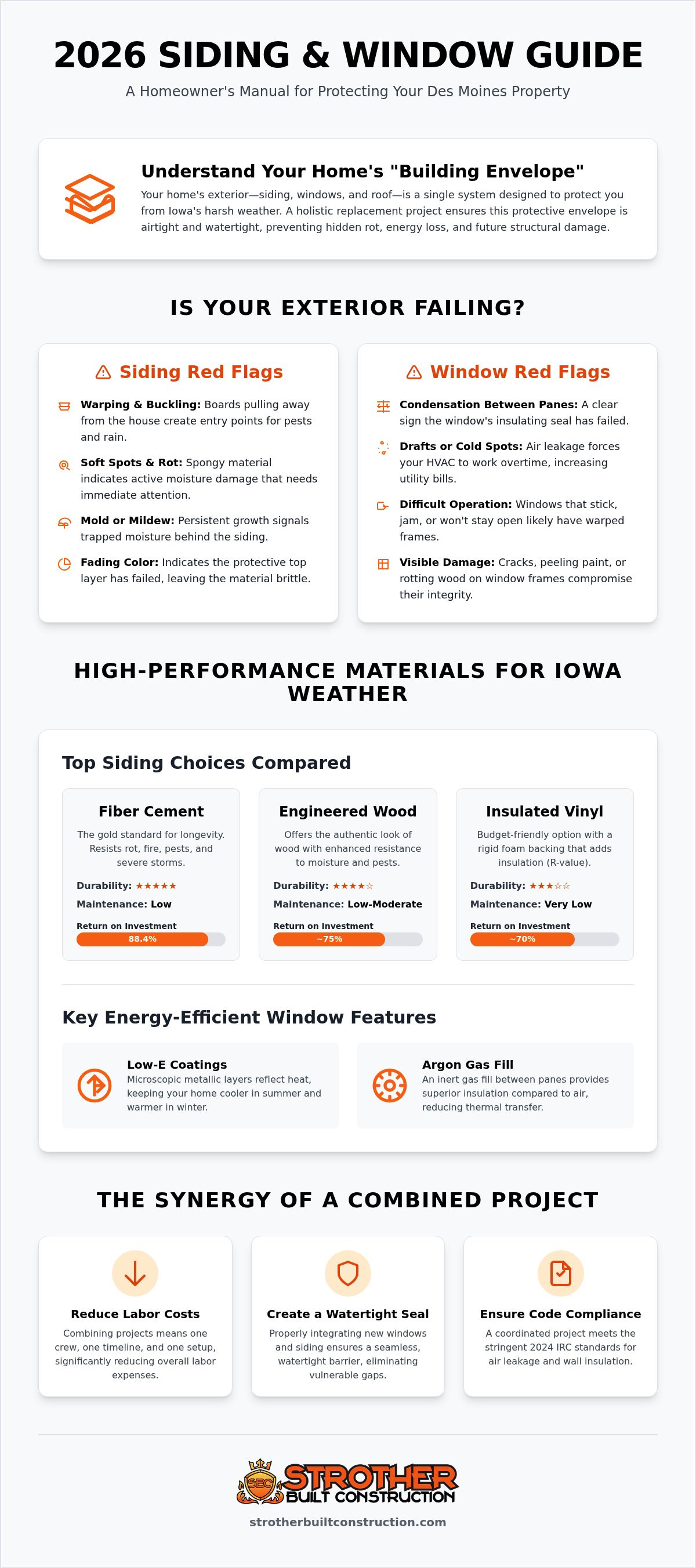
Your home’s exterior is more than just curb appeal; it’s a complex system designed to keep Iowa’s extreme weather outside. Professionals call this the building envelope. When you plan a home siding and window replacement as a single project, you ensure this envelope is airtight and watertight from the start. Replacing one without the other often leaves vulnerable gaps where moisture can seep into your wall cavities, leading to structural rot that stays hidden for years. Coordination is the key to a dry, comfortable home.
Start your assessment with a simple walk-around during the day. Look closely at the areas where different types of siding materials meet your window frames. If you see gaps, crumbling caulk, or daylight through the trim, your home is already losing energy. With Des Moines and surrounding metro areas adopting the 2024 International Residential Code (IRC) in early 2026, upgrading now ensures your home meets the newest, most stringent standards for air leakage and wall insulation. It is a proactive way to secure long term energy savings while prices for materials continue to shift.
Signs Your Siding Has Reached Its Limit
Walk the perimeter of your home and look for boards that are warping or buckling away from the house. These gaps are invitations for pests and driving rain. Take a screwdriver and gently press into any areas that look discolored or stained. If the material feels soft or spongy, you have active rot underneath that requires immediate attention. Persistent mold growth or extreme color fading also indicates that the protective top layer of your siding has failed. Once UV degradation sets in, the material becomes brittle and loses its ability to protect your home’s structure.
Window Failure Red Flags
Check your windows from the inside first. If you see fog or condensation trapped between the glass panes, the factory seal has failed. This means the insulating gas has escaped, and your window is now just a thin sheet of glass against the Iowa winter. Try opening every window in the house. If they stick, require heavy lifting, or won't stay open without a prop, the frames have likely warped. Feel for cold spots or moving air around the interior trim on windy days. These drafts are a clear sign that your windows can no longer hold back the wind, forcing your HVAC system to work overtime.
Selecting High-Performance Materials for Central Iowa Weather
Iowa’s climate demands materials that can survive a 120-degree temperature swing throughout the year. Between the -20°F wind chills of January and the 100°F humidity of August, your home’s exterior expands and contracts constantly. Choosing the wrong materials leads to cracks, warps, and high utility bills. A successful home siding and window replacement project relies on selecting products engineered specifically for the Midwest’s thermal stress. You need a shell that doesn't just look good but stays airtight when the prairie winds pick up.
Top Siding Choices for Durability
Fiber cement remains the gold standard for Iowa homeowners who prioritize longevity. It’s non-combustible and won't rot, making it incredibly resilient against our frequent summer storms. According to the Remodeling Impact Report, fiber cement siding offers a massive return on investment, often recouping 88.4% of its cost. It stands up to hail and high winds better than almost any other material on the market.
Engineered wood is another excellent option. It provides the warm, authentic look of traditional wood but includes modern resins and waxes that resist pests and moisture. If your budget is the primary concern, insulated vinyl acts like a thermal blanket for your house. It features a rigid foam backing that fills the gap between the siding and the wall. This adds a much-needed layer of R-value to combat those Des Moines winters and helps the panels stay straight and true over time.
Energy-Efficient Window Features
When it comes to windows, glass technology is where you’ll see the most impact on your monthly bills. Low-E coatings are microscopic metallic layers that reflect heat. In the summer, they keep the sun’s warmth out; in the winter, they bounce your furnace’s heat back inside. Argon gas fills the space between the panes to provide superior insulation compared to plain air. For most Des Moines homes, double-pane glass is the standard, but triple-pane options are becoming more popular for their superior noise reduction and thermal performance.
Frame material matters just as much as the glass. Fiberglass frames have the lowest expansion rate, meaning they won't pull away from your siding during a deep freeze. Premium vinyl is a cost-effective choice that offers great U-Factors and requires zero painting. For historic neighborhoods, wood-clad windows offer the beauty of real wood inside with a protective aluminum shell outside. Upgrading to high-performance windows can reduce your annual heating and cooling costs by 12% to 33%. If you're ready to see these materials in person, our exterior services experts can guide you through the best options for your specific home style.
Maximizing ROI: Why Siding and Window Synergy Matters
Many homeowners treat exterior upgrades as a series of disconnected tasks. They might replace a few windows this year and think about siding the next. This approach often leads to higher costs and missed opportunities for structural protection. A combined home siding and window replacement project is technically superior because it allows your contractor to address the entire building envelope at once. By opening the walls one time, you save thousands in labor costs that would otherwise be spent on separate setup, tear-down, and trim integration phases. It is the most efficient way to ensure your home remains a high-performance system.
This synergy also significantly boosts your home remodeling Des Moines resale value. When a potential buyer sees a unified exterior where the windows and siding were clearly designed to work together, it signals that the home has been meticulously maintained. In the 2026 Iowa real estate market, energy efficiency is a top priority for buyers. Presenting a home with a fully integrated, weather-tight shell provides a level of buyer confidence that "piecemeal" renovations simply cannot match.
Preventing Water Damage at the Source
The "Flash and Wrap" secret is the primary reason to do these projects together. When we remove your old siding, we gain full access to the window’s rough opening. This allows us to integrate the new windows directly with the house wrap, creating a continuous moisture barrier. Proper flashing is then applied to shed water away from the structural framing. If you install windows after new siding is already in place, you risk breaking that seal or relying on caulk alone to keep out the rain. A professional design-build firm ensures these technical details are handled correctly, protecting your home from the hidden structural rot that often plagues Iowa houses.
Boosting Curb Appeal and Resale Value
Visual consistency is just as important as structural integrity. Utilizing architectural design services Des Moines allows you to coordinate trim, siding colors, and window frame finishes for a modern, high-end look. Instead of trying to match new siding to five-year-old windows, you can create a cohesive palette from the start. This unified aesthetic has a direct impact on street appeal and property appraisals. For a deeper look at how these choices influence your home's worth, check out our exterior home remodeling Des Moines guide. Investing in a total transformation today pays off in both daily enjoyment and long-term equity.
Step-by-Step: Managing Your Exterior Remodeling Project
A successful home siding and window replacement project doesn’t happen by accident. It requires a disciplined, phased approach that respects both your daily life and the technical demands of the job. By following a structured process, we eliminate the guesswork and ensure your home’s transformation is as smooth as possible. We treat your property with the respect it deserves from the first consultation to the final cleanup.
Step 1: The Design Phase. Every great project starts with a clear vision. We use modern visualization tools to show you how different textures and colors will look on your specific house. This is the time to finalize the architectural details that will define your home's character for the next thirty years.
Step 2: Material Sourcing. In 2026, navigating Iowa supply chains requires foresight. We secure your specific window units and siding panels early to account for lead times. This ensures that every component is on-site and ready to go before we ever remove a single piece of old siding.
Step 3: Site Prep. We take extensive measures to protect your landscaping. This includes using specialized guards for your foundation plantings and shielding your Ankeny outdoor living spaces from dust and debris. We want to protect your existing investments while we build your new ones.
Step 4: Installation. The sequence is vital for a watertight home. We install the windows first. This allows us to properly integrate the flashing with the house wrap before the siding panels go up. It is the only way to guarantee the "Flash and Wrap" seal discussed in previous sections.
Step 5: Final Walkthrough. We don't consider the job done until we've inspected every miter joint and sealant bead together. We verify that every detail meets our high standards for craftsmanship and your personal satisfaction.
What to Expect During Construction
Construction is inherently loud and messy, but we work hard to minimize the impact on your family. Expect some noise and dust during the workday. We maintain a clean job site with daily debris removal to keep your driveway and lawn clear. Inside your home, please clear the areas around your windows. Removing blinds and moving furniture back a few feet gives our installers the space they need to work safely. Your project manager will be your steady point of contact for any questions along the way.
Timeline and Scheduling in Iowa
Timing is everything in the Des Moines area. Late spring through late autumn offers the most predictable weather for exterior work. While we can work through the winter, extreme cold can sometimes slow down material handling and sealant curing. A standard whole-home renovation usually takes between two to four weeks. We monitor local Polk County forecasts closely and adjust our schedule to ensure your home’s structure is never left vulnerable to a sudden storm. Ready to get your project on the calendar? You can start your exterior transformation today with our expert team.
Selecting a Local Design-Build Partner in Des Moines
Choosing a partner for your home siding and window replacement is the most critical decision you'll make for your property. While a solo "siding guy" might offer a tempting bid, an award-winning general contractor brings a level of structural accountability and integrated design that protects your investment for decades. You aren't just buying materials; you're buying peace of mind and professional project management. A design-build firm acts as your authoritative local guide, leading you through a complex process with transparency and a straightforward work ethic.
In Central Iowa, local expertise is non-negotiable. As of 2026, Des Moines and surrounding suburbs have adopted the 2024 International Residential Code (IRC). A local partner understands these specific Polk County building codes, particularly the requirements for R-20 wall insulation and air leakage testing. This ensures your project is not only beautiful but fully compliant and built to survive the next derecho or deep freeze. Integrated architectural and interior design services allow for a holistic look that considers how your new windows will impact your indoor spaces as much as your curb appeal.
The Design-Build Advantage
The design-build model eliminates the typical friction between an architect's vision and a builder's reality. You enjoy a single point of contact from the initial sketch to the final nail. This integrated approach means your architectural design services and exterior services are handled by the same team. We catch potential issues during the design phase rather than discovering them halfway through construction. This reduces stress and ensures that the final result matches the aspirational vision you had at the start.
Questions to Ask Your Des Moines Contractor
Before signing any contract, verify that your partner is registered with the Iowa Department of Inspections, Appeals, and Licensing (DIAL). This is a state requirement for all contractors operating in Iowa. Ask these specific questions to gauge their local experience and commitment to quality:
Are you licensed and insured for major structural exterior work in Iowa? This protects you from liability and ensures the team is qualified for complex envelope work.
Can you provide local references from Waukee, Ankeny, or West Des Moines? Seeing recent work in your specific neighborhood is the best way to verify craftsmanship and local reliability.
What is your process for discovering and fixing hidden rot? As we discussed in earlier sections, moisture behind old siding is a major concern. A professional partner should have a clear, transparent protocol for remediation rather than just covering up the problem.
Protect Your Investment with a High-Performance Exterior
Your home is likely your largest investment, and protecting it from Iowa's unpredictable weather is a full-time job for your exterior. By choosing a combined home siding and window replacement, you're doing more than just updating colors; you're building a high-performance shell that lowers utility costs and prevents structural rot. The "Flash and Wrap" technique we discussed creates a watertight seal that individual, piecemeal projects often miss.
Now is the time to turn your vision into a reality. At Strother Built Construction, we bring 13+ years of building trust in Central Iowa and award-winning Des Moines craftsmanship to every project. Our comprehensive design-build approach ensures that every detail, from architectural design to the final trim, is handled with precision and care. We take the stress out of remodeling so you can focus on the excitement of seeing your home's transformation.
Start Your Exterior Transformation with Strother Built today. We're ready to help you build something beautiful that lasts for decades.
Frequently Asked Questions
Is it better to replace windows before or after siding?
It’s technically superior to replace windows before or during your siding project. This sequence allows our team to properly integrate the window flashing with the house wrap. It creates a continuous, watertight seal that protects your home’s structural framing. If you wait until after the siding is installed, you risk damaging the new exterior or relying on caulk alone to prevent moisture from seeping into your wall cavities.
How much does a typical home siding and window replacement cost in Iowa?
Industry data for Central Iowa suggests that a typical full siding replacement for a 1,500 square foot home often averages around $12,000. For windows, basic vinyl units usually start near $400 per window, while premium options can reach $1,200 each. These market averages vary significantly based on your choice of materials. Every home siding and window replacement project is unique to the property's specific architectural needs and square footage.
What is the most durable siding material for the Des Moines climate?
Fiber cement is widely considered the most durable choice for the extreme temperature swings in Des Moines. It handles the shift from -20°F winters to 100°F summers without warping or cracking. Engineered wood is another high-performance contender that resists pests and moisture while offering a natural aesthetic. Both materials provide the structural integrity required to survive Iowa’s frequent summer storms and high-wind events better than standard vinyl options.
Can I replace just my siding without replacing my windows?
You can replace siding independently, but you lose the opportunity to create a perfect moisture barrier. Replacing windows later often requires cutting into your new siding and trim, which can compromise the watertight seal. If your windows are more than 15 years old, we recommend doing both at once. This unified approach protects your building envelope and ensures your interior stays dry during heavy Iowa rainstorms.
How long does a full exterior home remodel take?
A comprehensive whole-home exterior renovation typically takes between two to four weeks to complete. This timeline includes the removal of old materials, structural inspections for rot, and the precise installation of your new systems. While we work efficiently, Iowa’s weather can occasionally cause minor delays. We monitor local forecasts in Polk County daily to ensure your home’s structure remains protected and dry throughout the entire construction process.
Are there tax credits for energy-efficient windows in 2026?
Yes, the federal Energy Efficient Home Improvement Tax Credit provides a 30% credit for qualifying energy-efficient windows and doors through 2032. This allows homeowners to claim a significant portion of their material costs on their annual taxes. Additionally, the Iowa HOMES and HEEHRA rebate programs are expected to provide further financial incentives for energy-efficient retrofits. These programs make 2026 an excellent year to invest in high-performance exterior upgrades that reduce long term costs.
How do I maintain my new siding and windows to ensure they last?
Regular maintenance starts with an annual visual inspection of your home’s perimeter. Clean your siding once a year with mild soap and a soft brush to remove dirt and organic growth. For windows, clear debris from the tracks and check that the weep holes are not clogged. Inspect the caulking around your window frames every spring. Catching small gaps early prevents moisture from bypassing your protective barrier and causing expensive structural issues later.


Comments