


Home Addition ROI Calculator Iowa: Estimate Your Project’s Value

Could a home addition that makes daily life easier still return less than you expect at resale? That’s why a home addition ROI calculator Iowa homeowners use should be a planning tool, not a promise of profit. Online percentages can offer a starting point, but they may not reflect your home, your neighborhood, or the scope you’re considering.
Before committing to a major project, build a preliminary estimate from your projected costs and a realistic range for potential resale value. Then compare the result with the space’s everyday benefits and alternatives, such as remodeling or moving. Keep confirmed estimates separate from assumptions so it’s clear which figures still need refining.
This guide explains how to estimate potential return, compare addition options, and account for local market factors that can shift the numbers. You’ll also see how scope and coordinated architectural design and construction planning can help align a project with your priorities. For homeowners in Des Moines, Ankeny, West Des Moines, Waukee, Altoona, Polk City, Bondurant, Grimes, Ames, Huxley, Norwalk, and Indianola, the goal is clearer expectations, not a guaranteed resale outcome.
Table of Contents
What a Home Addition ROI Calculator in Iowa Can, and Cannot, Tell You
A home addition ROI calculator Iowa homeowners use can organize a decision, but it can’t predict the exact sale price of a future home sale. Treat the result as a planning comparison between the project investment and an estimated change in property value. The estimate depends on assumptions about the home, the work, and the market, so it isn’t an appraisal or a promise of dollar-for-dollar recovery.
Estimated ROI is a planning estimate, not a guaranteed resale outcome. Keep the financial estimate separate from the value you experience every day. A bedroom that gives a growing family room to spread out, or a more functional layout that makes routines easier, may be worthwhile even if the estimated resale gain is lower than the project investment. The broader reasons people renovate, including improving how a home works for them, are outlined in Renovation.
What does home addition ROI mean?
ROI compares a project’s investment with the change in property value you estimate it may create. That change is the gross resale value gain. A net return accounts for project expenses against that gain. If the estimated value increase is smaller than the investment, the calculation may show that the project won’t recover its full cost at resale. A calculator processes the figures and assumptions you enter; it doesn’t establish market value.
Why can two Iowa additions produce different estimates?
Context matters. Two homes with the same amount of added space can differ in layout, existing condition, neighborhood, and how well the new area connects to the original house. An addition that solves a clear space or function gap may appeal differently to buyers than one that feels disconnected or exceeds what’s typical nearby. Local buyer preferences and comparable properties help shape an estimate, but no single sale accounts for every difference.
Scope and workmanship also affect the result. Depending on local demand, a modest addition that fits the home may compare more favorably with nearby properties than a larger, highly customized project. Timing matters, too: buyer interest and available comparable sales can change between planning and resale. Use the home addition ROI calculator Iowa as a way to test assumptions, not as a reliable prediction based on a single percentage.
For homeowners in Des Moines and nearby Iowa communities, coordinated architectural design and construction planning can clarify what the addition needs to accomplish and how its scope supports those priorities. That gives you a more grounded starting point for evaluating both potential resale considerations and the space’s day-to-day value.
How to Calculate a Preliminary Home Addition ROI
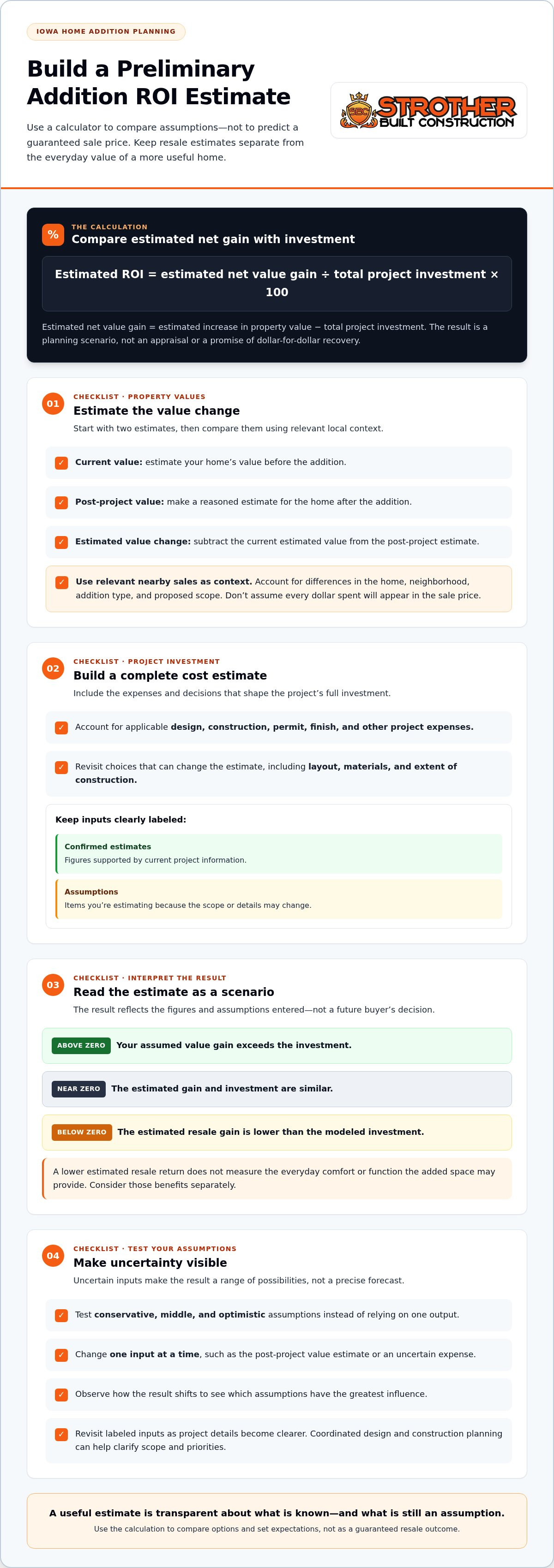
Start with a comparison, not a promise. A preliminary calculation shows how an estimated change in resale value compares with the full project investment. Use this formula:
Estimated ROI = estimated net value gain ÷ total project investment × 100
For this calculation, estimate the net value gain by subtracting the total project investment from the estimated increase in property value. A result above zero suggests the estimated gain exceeds the investment; a result near zero suggests they’re similar; and a result below zero suggests the estimated gain is lower. These are planning scenarios, not guaranteed outcomes.
Which figures should the calculator include?
Start with two property-value estimates: your home’s current estimated value and a reasoned estimate of its value after the addition. The difference is your estimated value change. Base the post-project figure on relevant local comparables and the proposed scope, rather than assuming every dollar spent will appear in the sale price.
Next, build a complete investment estimate. Include applicable design, construction, permit, finish, and other project expenses. As the scope develops, account for the decisions that can change the estimate, such as the layout, materials, and extent of construction. Keep the figures organized:
Confirmed estimates: figures supported by current project information.
Assumptions: items you’re estimating because the scope or details may change.
Label each input and revisit it as decisions become clearer. Reports such as the National Association of REALTORS® Remodeling Impact Report can provide broader context for remodeling value, but local conditions and your specific home still matter.
How should you interpret the result?
Uncertain inputs make your result a range, not a precise forecast. A positive estimate means your assumed value gain exceeds the investment; it doesn’t mean a future buyer will pay that amount. A neutral estimate suggests the figures are close. A negative estimate means your projected resale gain falls short of the modeled investment, though the addition may still offer daily-use benefits.
Test conservative, middle, and optimistic assumptions instead of trusting one output. Change one input at a time, such as the estimated post-project value or an expense that remains uncertain, and observe how the result shifts. This makes the calculation more transparent and shows which assumptions have the greatest influence.
As the estimate takes shape, coordinated design and construction planning can help bring project priorities and scope into clearer focus. Discuss your home addition plans as a next step in turning early assumptions into a buildable plan.
How Iowa Comparables and Addition Types Shape Your Estimate
A resale estimate becomes more grounded when it reflects homes buyers have actually purchased near you. Comparable sales can show how the local market values similar properties, but they’re reference points, not a precise forecast for your home. A home addition ROI calculator Iowa homeowners use is only as useful as the local evidence and assumptions behind its estimated post-project value.
How do you find useful Iowa comparable properties?
Look for nearby homes that resemble yours in size, condition, layout, and relevant features. The closer the match, the more useful the comparison. If possible, focus on completed sales and note when they closed. Asking prices show what sellers hope to receive, not what a buyer ultimately paid.
Even nearby sales have limits. A comparable home may have a different renovation history, lot, or room arrangement. Treat any comparison as one input and account for the differences between that property and your own.
Keep market figures specific: identify the source, date, and geographic area, such as a particular Des Moines neighborhood rather than all of Iowa. Statewide trends may not reflect demand on your street. Verify figures before relying on them, and avoid applying an old or broad statistic as though it describes your home’s immediate market.
Do different addition types affect resale estimates differently?
Consider what each space adds to the home’s function and how naturally it fits the existing layout. An added bedroom may address a household’s need for privacy or flexibility. Another bathroom may ease busy routines. A larger living area can create room for gathering, while an expanded kitchen may improve movement, storage, or connection to nearby spaces. Buyer appeal depends on local preferences, the home’s existing features, and the quality of the finished work, not just the added square footage.
Fit matters. A well-planned addition that feels connected to the original home can be more useful than an equally sized space with awkward access or little connection to daily life. Finish quality and the condition of the rest of the property also shape how buyers may perceive the improvement.
Compare an addition with changes to your existing layout or a broader remodeling project. The Des Moines home remodeling guide can help frame that comparison. Use comparable sales to inform your assumptions, then weigh each option by both its likely buyer appeal and the function it brings to your household.
Addition, Remodel, or Move: Compare the Trade-Offs Before Deciding
An addition may not recover its full investment at resale. That doesn’t automatically make it the wrong choice, but it does make comparison worthwhile. Put three questions side by side: What space or function do you need? Can your current home provide it with a remodel? Would moving solve the problem more effectively, given the location and features you value?
Moving may offer a different layout or more space, but it also means leaving a familiar neighborhood and weighing the effort of a new home search and transition. An addition keeps you in place and creates room tailored to your household, though construction can disrupt daily routines. Remodeling existing rooms may improve how the home works without adding square footage, but it can’t solve every space constraint.
When might remodeling existing space be worth comparing?
Start with the rooms you already have. Could an underused area serve a better purpose? Could a revised layout improve movement, storage, or how rooms connect? If so, compare the scope of that remodel with the space and function an addition would provide. Architectural planning can help clarify those possibilities; explore the Des Moines architectural design services guide for more on planning considerations.
Keep the comparison specific. List the needs each option would meet, the changes each would require, and the disruption your household would need to manage. Use project-specific estimates rather than assuming one path is automatically less demanding or better financially.
How do personal priorities change the decision?
Your time horizon matters. If you expect to stay for years, daily comfort and function may carry more weight than a near-term resale estimate. If a move is already on the horizon, you may place greater emphasis on how the project could affect future buyer appeal. In either case, keep lifestyle goals separate from financial assumptions so one doesn’t quietly stand in for the other.
Location can tip the balance. Staying near work, school, family, or community ties may be a strong reason to improve the home you have. Accessibility needs or room for relatives may also matter more than maximizing estimated resale recovery. A home addition ROI calculator Iowa homeowners use can support the financial comparison, but it can’t decide which trade-offs fit your life.
Compare your options with Strother Built Construction’s home addition and remodeling planning as a starting point for shaping a project around your household’s needs.
Turn Your Iowa Home Addition Estimate into a Buildable Plan
A preliminary estimate becomes more useful when you connect it to a clear description of what the project needs to do. Record your assumptions, then refine them as the design and scope take shape. This keeps the focus on the spaces your household needs, not just a calculator result.
What should your addition project brief include?
Write down the goals first. Are you hoping to create a bedroom, make room for family gatherings, or improve how the home functions day to day? Then note the layout you have in mind and the features that matter most. Separate essentials from preferences so you can see where there may be room to adjust the scope.
Household goals: Describe who will use the new space and what it should help them do.
Layout and features: Note desired room connections, storage, natural flow, and must-haves.
Estimate assumptions: Record your preliminary investment and resale figures, marking which are confirmed and which need refinement.
Planning questions: List property conditions, local approval steps, and scope details that need attention as the project develops.
Keep this brief practical. It doesn’t need finished drawings. It should give a clear starting point for discussing priorities and the choices that could affect the plan.
How can design-build planning refine an ROI estimate?
Architectural design can translate broad goals into a proposed layout and defined scope. Interior design helps connect the room’s appearance and finishes with how you plan to use it. Coordinating those decisions with construction planning can reveal where the project may need adjustment before the work moves forward.
For example, “more family space” could mean an open gathering area, improved connection to the kitchen, or a separate room for quieter activities. Each direction creates a different scope. Material and layout choices can also affect the project investment and the space’s usefulness. As these details become clearer, revisit the inputs in your home addition ROI calculator Iowa estimate. The updated result can support planning, but it still shouldn’t be treated as a promised resale outcome.
Strother Built Construction brings home additions together with architectural and interior design services to help shape a plan around your priorities. Discuss your home addition with Strother Built and take the next step toward a buildable project plan.
Make Your Next Step a Clear One
A home addition ROI calculator Iowa homeowners use can bring project assumptions into focus, but it can’t promise what a future buyer will pay. Build your estimate from project-specific investment figures and relevant local sales, then compare an addition with remodeling or moving. Keep daily comfort and function in the picture, too. Those benefits matter even when they don’t show up in a resale calculation.
Once your goals and priorities are clear, turn the estimate into a practical project brief. Strother Built Construction is locally owned and operated by Josh Strother, with experience in home additions and remodeling. Integrated design and construction services help connect your desired space with a considered scope and plan.
Ready to explore what could work for your home? Discuss your home addition plans with Strother Built. A clear starting point can make the possibilities easier to shape and help you move forward with confidence.
Frequently Asked Questions
How do I calculate the ROI of a home addition in Iowa?
Estimate the home’s value change, subtract the total project investment, then divide that net amount by the investment and multiply by 100 for a percentage. A home addition ROI calculator Iowa homeowners use is only as useful as its inputs. Base value estimates on your property and nearby completed sales, and include design, construction, and related expenses. Mark uncertain figures clearly. The result is a planning estimate, not a promise of what a future buyer will pay.
Is a home addition a good investment in Iowa?
It depends on your property, neighborhood, project scope, and household needs. Nearby comparable sales can help frame possible resale appeal, but they can’t guarantee future value. For a local perspective, compare homes near Des Moines, Ankeny, West Des Moines, Waukee, Altoona, Polk City, Bondurant, Grimes, Ames, Huxley, Norwalk, or Indianola. Weigh that market context alongside the addition’s everyday usefulness, such as improved function or room for family.
Can a home addition increase resale value more than it costs?
It can, but there’s no guaranteed outcome. The result depends on the total investment, buyer demand in your area, the addition’s function, and how naturally it fits the home. Compare more than one estimate using relevant local sales, rather than relying on a generalized percentage. Keep projected resale value separate from the personal benefit of added space so your financial estimate stays realistic.
What should I include in a home addition ROI calculator?
Include estimated property values before and after the addition, then calculate the expected value change against your total project investment. Account for applicable design, construction, permit, finish, and other project expenses using figures specific to your plan. Label assumptions separately from confirmed estimates and test different scenarios as details change. The calculator can help structure your decision, but it isn’t an appraisal or an exact prediction of a sale price.
How much value does adding a bedroom or bathroom add in Iowa?
There isn’t one reliable value amount for every Iowa home. The effect can vary with location, existing layout and condition, the addition’s quality, and nearby buyer preferences. Compare similar homes in your area and note the source, date, and geographic scope of any market figures you use. Avoid applying a national percentage as if it predicts your property’s result. A bedroom or bathroom’s usefulness and fit matter, too.
What happens if my home addition costs more than the value it adds?
A lower estimated resale return doesn’t automatically make the project a poor choice. Added space may support comfort, accessibility, or daily routines for years. Review your assumptions and project scope, then compare the addition with remodeling existing rooms or moving. Consider how long you plan to stay and which needs matter most. A clear estimate helps you weigh financial expectations alongside the home’s value to your household.

Comments